
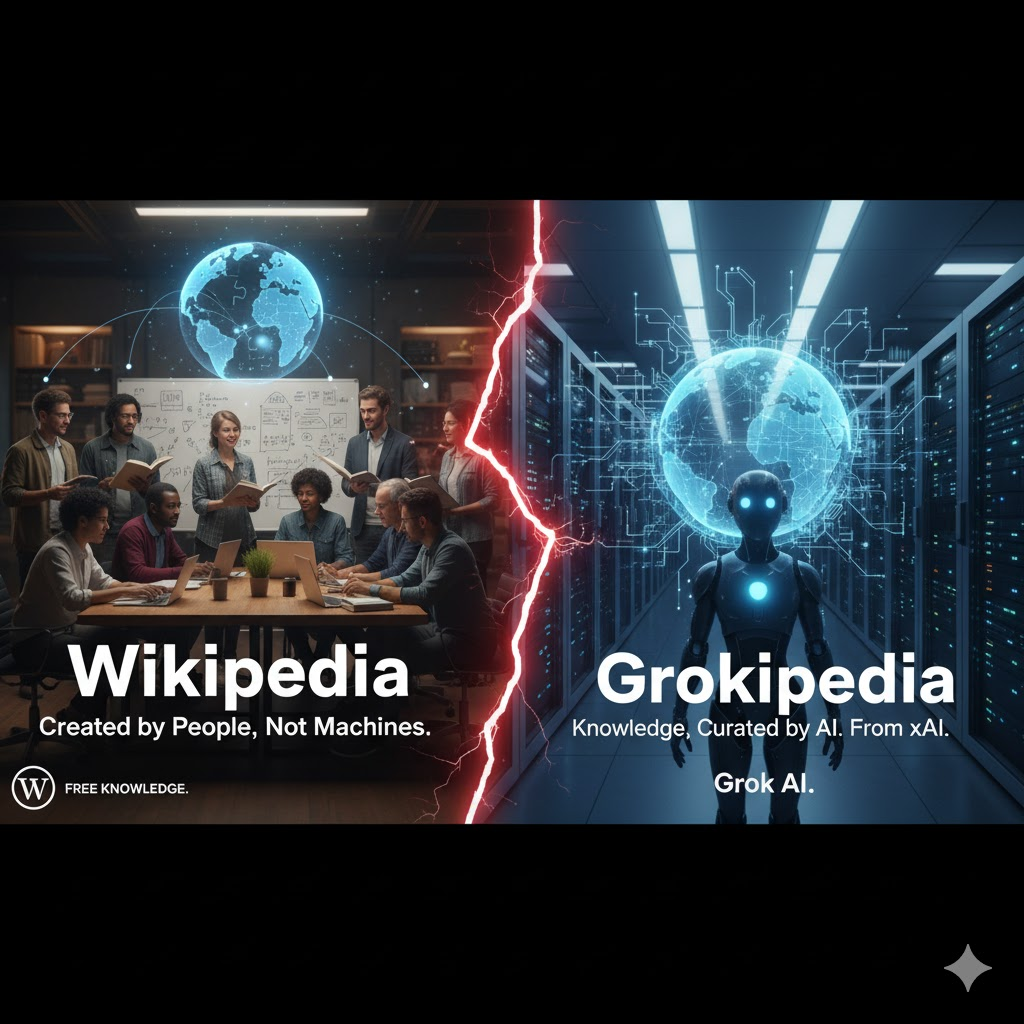
Grokipedia vs. Wikipedia: The Battle for Online Knowledge
The digital landscape of information has been profoundly shaped by Wikipedia for over two decades. As the internet’s largest and most consulted encyclopedia, it became the quintessential example of crowdsourced knowledge. However, a new challenger has emerged from the labs of Elon Musk’s xAI: Grokipedia. Launched with the promise of a less biased, AI-driven alternative, Grokipedia has ignited a fierce debate about the future of online encyclopedias, the role of artificial intelligence in content creation, and the very definition of factual neutrality.
This article will explore the core tenets, strengths, and weaknesses of both platforms, offering a clear comparison of their distinct approaches to compiling and disseminating knowledge.
1. Core Philosophy and Creation Process
The fundamental difference between Grokipedia and Wikipedia lies in their very genesis and operational philosophy.
Wikipedia: The Power of the Crowd Wikipedia operates on a model of human-centric, community-driven editing. Its millions of articles are created, reviewed, and updated by a global network of volunteer editors. This approach emphasizes consensus, diverse perspectives, and verifiable sources, leading to a sprawling, multi-lingual compendium of human knowledge. The Wikimedia Foundation, a non-profit organization, governs it, ensuring its open-source and ad-free nature.
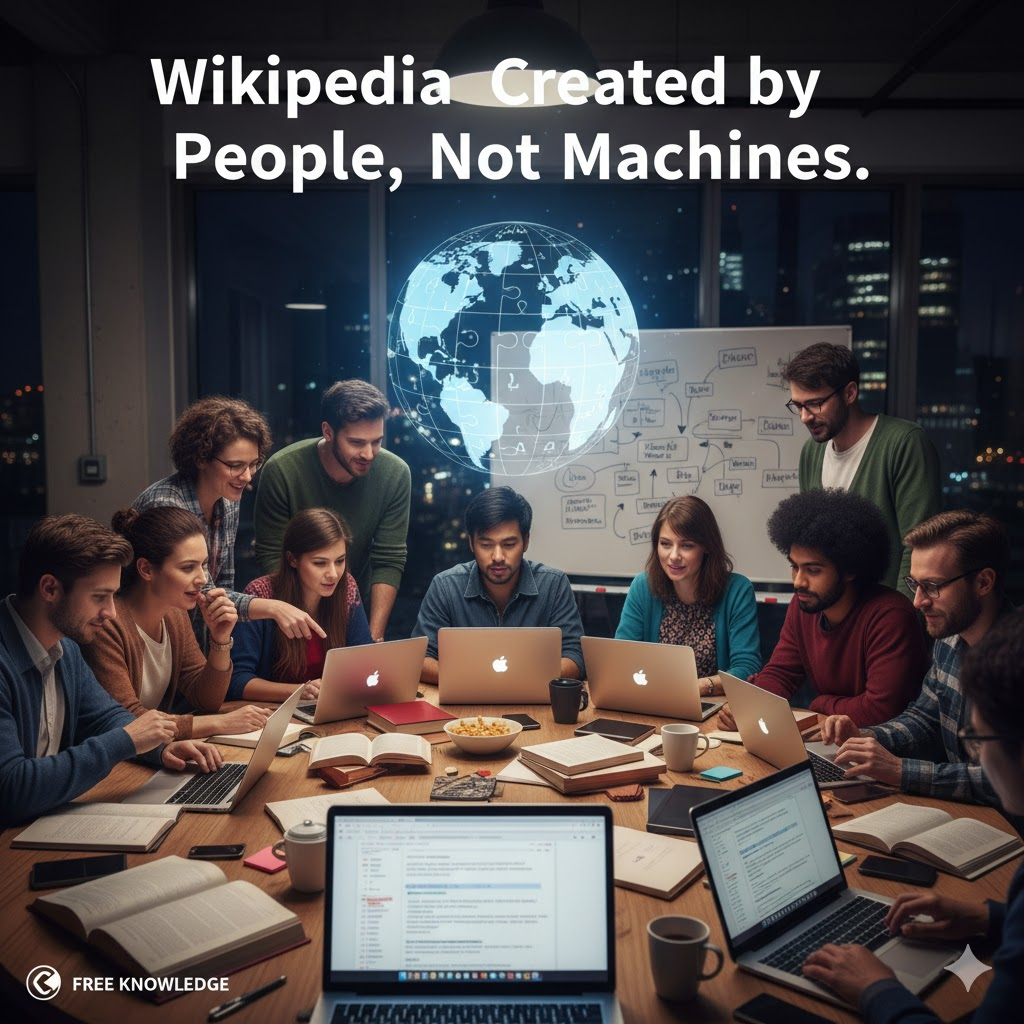
A bustling newsroom-like setting with diverse people actively collaborating on laptops, whiteboards visible with diagrams, reflecting the community-driven, human-edited nature of Wikipedia. Text overlay: “Wikipedia Created by People, Not Machines.”
Grokipedia: The Dawn of AI-Generated Knowledge In stark contrast, Grokipedia is primarily an AI-generated encyclopedia, powered by xAI’s Grok large language model. Its articles are drafted, compiled, and updated by artificial intelligence, theoretically allowing for rapid content generation and integration of real-time data. Elon Musk launched Grokipedia with the stated aim of offering a “more accurate and less biased” information source, claiming Wikipedia suffers from ideological slant.
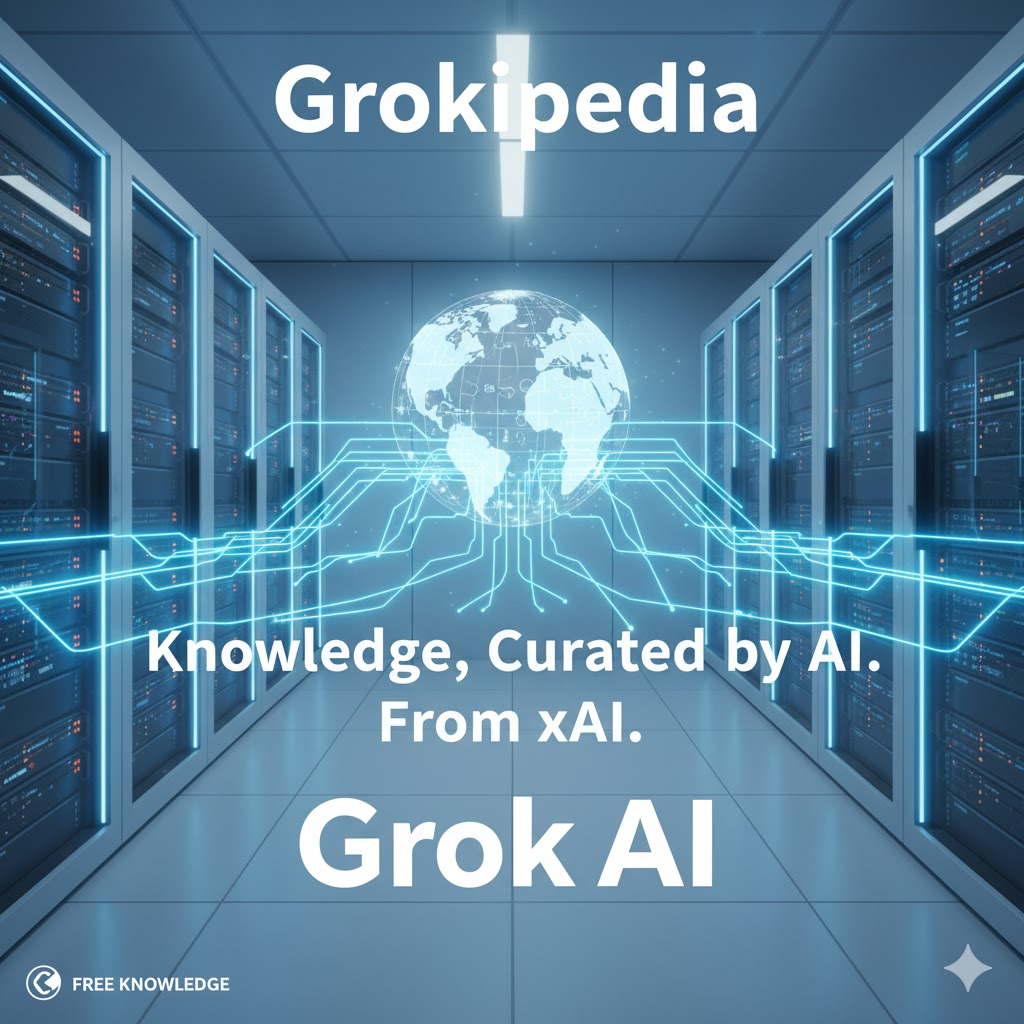
A sterile, futuristic server room with glowing blue circuit lines emanating from a central holographic globe, symbolizing AI’s role in data processing and content generation for Grokipedia. Text overlay: “Grokipedia Knowledge, Curated by AI. From xAI. Grok AI”
2. Scope and Scale
Wikipedia, with its decades of development, holds a commanding lead in terms of sheer volume and depth.
Wikipedia’s Vast Ocean of Information With millions of articles in hundreds of languages, Wikipedia covers an unparalleled breadth of subjects, from ancient history to obscure scientific theories. Its extensive archives provide historical context and evolution of topics, often linked through a dense web of internal references.
Grokipedia’s Nascent Library Launched as version 0.1, Grokipedia began with approximately 885,000 articles. While impressive for an AI-generated launch, this is a fraction of Wikipedia’s content. Its scope is currently narrower, focusing on topics amenable to real-time data integration and those with a strong presence on platforms like X (formerly Twitter).
3. Accuracy and Bias: The Central Debate
This is where the battle truly rages. Grokipedia was founded on the premise of rectifying what its creators perceive as Wikipedia’s inherent biases.
Wikipedia’s Pursuit of Neutrality Wikipedia’s core content policy is “Neutral Point of View (NPOV),” striving to represent all significant viewpoints fairly, proportionally, and without bias. While human editors can introduce bias, the community’s rigorous peer-review process, dispute resolution mechanisms, and emphasis on verifiable sources aim to correct it over time. Critics, however, argue that despite these efforts, systemic biases (e.g., Western-centric, left-leaning) persist.
A split image. On the left: a diverse group of people collaborating around laptops and a whiteboard with diagrams (Wikipedia). On the right: a sterile, futuristic server room with glowing circuits and a robot (Grokipedia). A lightning bolt separates the two halves, symbolizing their opposition. Text overlays are visible from previous image prompts.
Grokipedia’s AI-Driven Objectivity Grokipedia’s promise is that an AI, devoid of human emotion and ideological baggage, can generate a more objective truth. The Grok AI model is designed to process vast amounts of data, including real-time information from X, to produce articles. However, early observations have raised concerns:
- AI Bias Inheritance: AI models learn from the data they’re trained on. If that data contains biases, the AI can perpetuate or even amplify them.
- “Hallucinations”: LLMs are known to sometimes “hallucinate” or confidently present false information as fact.
- Right-Leaning Slant: Some early reviewers have noted a right-leaning or anti-establishment slant in certain Grokipedia articles, ironically reflecting the very bias its creators accused Wikipedia of having.
- Source Adaptation: Many Grokipedia articles appear to be adaptations of Wikipedia content (under Creative Commons licenses), which raises questions about its originality and how much new, unbiased information it’s truly generating.
4. Timeliness and Real-Time Information
This is an area where AI potentially holds a distinct advantage.
Wikipedia’s Deliberate Pace While Wikipedia editors are quick to update articles on breaking news, the process of consensus, verification, and citing reliable sources can take time. This ensures accuracy but might not always provide instantaneous updates.
Grokipedia’s Instantaneous Potential Grok AI’s ability to process real-time data from platforms like X allows Grokipedia to potentially update articles on breaking events with unprecedented speed. This could be a significant advantage for rapidly evolving news cycles, offering immediate context to current affairs.
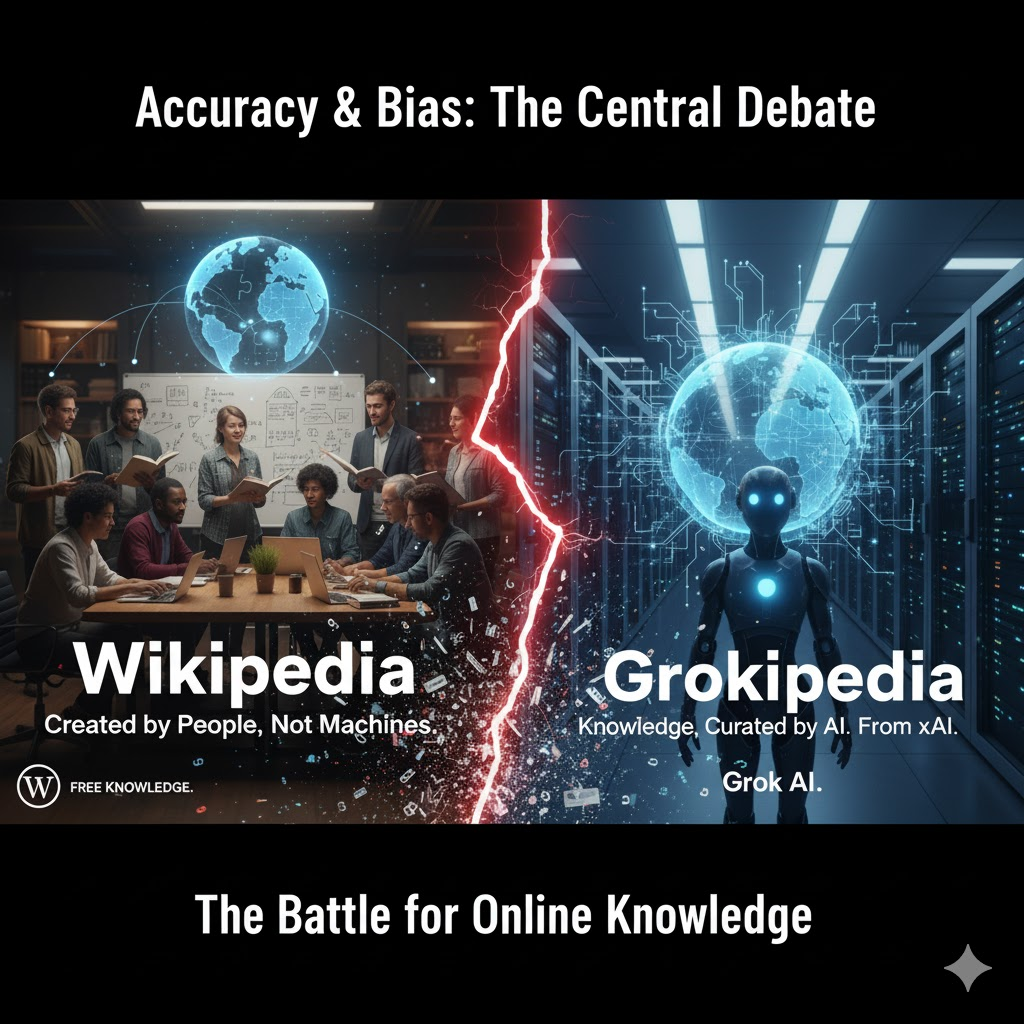
The same split image from before, featuring Wikipedia (humans) on the left and Grokipedia (AI) on the right, separated by a lightning bolt. Additional text overlays have been added: “Accuracy & Bias: The Central Debate” at the top and “The Battle for Online Knowledge” at the bottom, framing the existing text.
5. Ownership and Governance
The entities behind each platform reflect their differing missions.
Wikipedia: A Non-Profit, Community Asset Owned and operated by the non-profit Wikimedia Foundation, Wikipedia is funded by donations and committed to free and open knowledge for all. Its governance structure is designed to be transparent and accountable to its global community.
Grokipedia: A Commercial Venture by xAI Grokipedia is a product of xAI, a for-profit company founded by Elon Musk. While its exact business model for Grokipedia isn’t fully clear, its commercial backing and association with Musk’s other ventures (X, Tesla, SpaceX) naturally raise questions about potential commercial or political influences on its content.
Conclusion: A New Era for Information?
The emergence of Grokipedia marks a significant moment in the evolution of online information. It challenges the long-standing dominance of human-edited encyclopedias and forces a re-evaluation of how we define and consume knowledge in an AI-driven world.
While Wikipedia stands as a testament to collective human endeavor and democratic knowledge creation, Grokipedia represents the cutting edge of AI’s potential to synthesize and present information rapidly. The core question remains: Can an AI truly be “less biased” than humans, or will it merely reflect the biases of its training data and creators?
For now, both platforms offer distinct value propositions. Wikipedia provides comprehensive, rigorously vetted, and historically rich content, nurtured by a passionate community. Grokipedia, in its infancy, offers the promise of real-time insights and a fresh perspective, albeit one that is still being tested for accuracy and true neutrality. The future of online knowledge may not be about one triumphing over the other, but rather about how these two fundamentally different approaches coexist and inform our understanding of the world.